
Three Companies Building the Circular Tech Stack for Batteries: Valtera, ARC, and ReBattery
How Digital Infrastructure Is Unlocking Value in the Circular Battery Economy


As electric vehicles, energy storage systems, and electrified industrial equipment multiply globally, millions of lithium-ion batteries enter resale and recycling markets each year. By 2030, an estimated 1.2 million end-of-life EV batteries will require proper handling. By 2040, that number is projected to reach 14 million.1 Billions of consumer devices—power tools, phones, tablets, and laptops—add further to that figure.2
Managing this wave demands both physical and digital infrastructure. The core obstacle to circularity is often information gaps and a lack of trusted data that prevent efficient matching and decision-making across the battery lifecycle. These gaps also introduce growing safety and fire risks, as batteries with unknown state of health, chemistry, or damage history are improperly handled, stored, or transported, increasing the likelihood of thermal events. While recycling capacity is expanding, a large share of batteries is still misrouted, underpriced, or delayed due to fragmented data and poor coordination. That challenge is becoming more urgent as regulation catches up. In addition to the EU Battery Regulation, which will require a Digital Product Passport by 2027, battery governance is expanding to include growing safety requirements aimed at reducing thermal runaway and fire risk.3
A new digital tech stack is emerging to solve this. Comprising three layers—identity, intelligence, and marketplace—it makes batteries visible as first-class assets, turns data into actionable valuation and routing decisions, and coordinates buyers, sellers, recyclers, and logistics providers in efficient transaction workflows. Without this digital layer, physical infrastructure recovers less value and often takes longer to transact. With it, value recovery rises and deal cycles are compressed.
This article examines what that digital tech stack looks like in practice and how three pioneering companies are building its foundational layers. This innovation shows that battery circularity is often an information problem requiring a digital solution that complements and unlocks the value of the physical infrastructure being built around it.
The Digital Tech Stack
Battery circularity is often seen as a problem of physical infrastructure. People call for more collection points, more transport capacity, and more recycling plants. But in reality, a key constraint is often information. Throughout the battery lifecycle, critical data about identity, condition, location, and ownership is fragmented, inconsistent, or missing. This makes it hard to manage fleets efficiently, set accurate prices, match buyers and sellers in the secondary market, and reduce risks to enable more transactions.
A digital tech stack is being developed to address this. It has three connected layers that work together to turn batteries into tradable, data-rich assets and better address safety concerns.
The identity layer creates a persistent and verifiable record for each battery. Currently, batteries are often tracked through the vehicles, equipment, or facilities they are part of. But once they are removed from their original context, this tracking breaks down. Without a standardized identity, it is hard for downstream actors to verify a battery’s chemistry, configuration, usage history, or state of health, which affects everything from regulatory compliance to resale decisions. A dedicated identity layer provides a shared and auditable record that stays with the battery throughout its lifecycle, allowing consistent data access across organizations.
The intelligence layer builds on this foundation by using battery data to make decisions. Knowing what a battery is does not determine what should happen to it. Operators need to assess its value, estimate its remaining life, and decide whether to reuse, repurpose, or recycle it. Today, these decisions are often made manually and based on incomplete information. Intelligence systems gather technical data, historical performance, and market signals to estimate a battery’s state of health, forecast its remaining value, and recommend the best course of action. This shifts decisions from judgment calls to data-driven optimization and reduces both risk and processing time.
The marketplace layer carries out these decisions by coordinating transactions across a fragmented ecosystem. Even when battery characteristics and value are understood, matching supply with qualified buyers is often slow and inefficient. Transactions are typically managed through direct outreach, manual negotiation, and separate logistics processes. Digital marketplaces integrate discovery, pricing, compliance documentation, and logistics into a single workflow, enabling participants to transact more quickly and confidently. They can also manage the terms and conditions on which buyers and sellers are willing to share information and engage in a transaction.4
These layers are distinct but closely linked. Having an identity without intelligence provides standardized records but has limited economic value. Having intelligence without identity relies on incomplete or probabilistic data, which limits accuracy. Marketplaces without either layer revert to broker networks, where trust is established transaction by transaction rather than being embedded in the system. Together, the three layers reduce information gaps, speed up transaction cycles, and enable batteries to be routed to their most valuable next use—what the industry calls “second life,” or repurposing batteries for a new application before eventual recycling.
The economic benefits are significant. Data-driven routing increases value recovery by directing high-quality batteries to second-life applications rather than premature recycling. Improved matching reduces unnecessary transport and handling costs. Faster and more reliable transactions shorten deal cycles from months to days. The digital tech stack does not replace physical infrastructure. Rather, it makes physical infrastructure more economically effective.
Valtera
Valtera is a Colorado-based company building the identity layer of the battery stack—the infrastructure that gives each battery a persistent, trustworthy record across its entire lifecycle.5 The company’s core insight is that batteries are currently tracked as accessories to other assets: a VIN, an equipment spreadsheet, a facility disposal log. When a battery leaves active service, that indirect tracking breaks down. Dismantlers, recyclers, fleet operators, insurers, and regulators are left working from incomplete or unverifiable information about what they have, what condition it’s in, and how it should be handled.
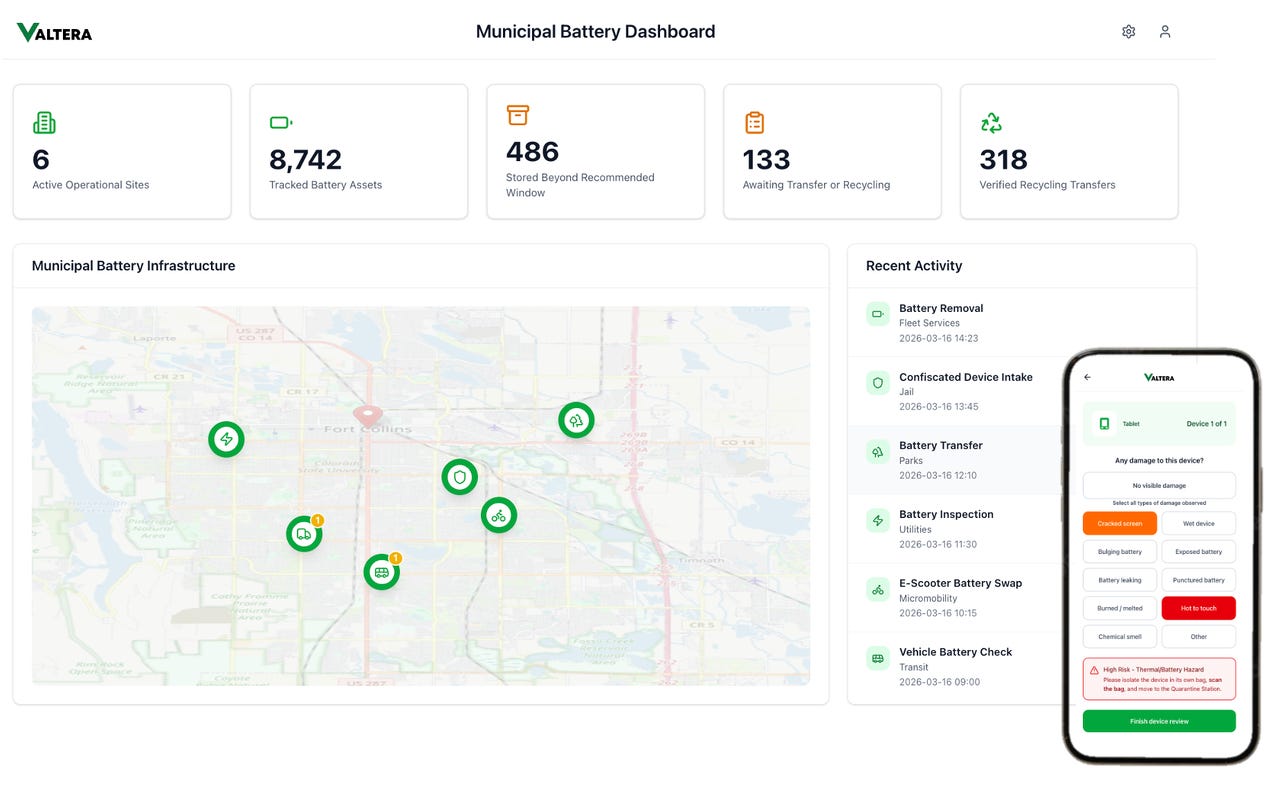
Valtera addresses this through a mobile app and platform designed around the moment batteries exit active service. At intake—whether a damaged EV arriving at a tow yard, a scooter battery removed from a micromobility fleet, a drill battery collected at a municipal facility, or consumer devices taken in at controlled intake points—operators scan, tag, or group assets and begin building a structured lifecycle record. From that point, the platform documents the operational events that matter: visible condition, custody transitions, storage duration, quarantine status, transfer events, and eventual recycling or disposition. This replaces fragmented notes, spreadsheets, and disconnected vendor systems with a single auditable record. Critically, the app is built to work offline, syncing automatically when connectivity returns. This is essential in environments where end-of-life batteries accumulate, such as correctional facilities, fleet yards, tow and storage environments, warehouses, and municipal operations where reliable internet access cannot be assumed.
What Valtera produces is not software for a single organization’s internal use. It can be a shared visibility infrastructure: a neutral chain-of-custody record, distinct from existing operational systems, that all stakeholders can access against the same underlying data. Operators, municipalities, recyclers, insurers, facilities, and logistics partners can all engage with the same lifecycle record. A record created at intake by a fleet operator should be readable and credible to a recycler or regulator downstream, without either party starting from scratch.
Valtera’s current focus spans three horizontal markets: Municipal/EV Fleet, Micromobility, and Controlled Facilities. These are environments that share the common challenge of managing battery assets across fragmented, often connectivity-constrained operations.
This shared record is also what makes intelligence and marketplace functions possible further downstream. Without a consistent identity layer, the valuation and routing decisions that ARC enables and the transactions that ReBattery closes must rely on incomplete or unverifiable data. Valtera provides the foundation on which the rest of the stack depends. In regulatory terms, this positions Valtera as the practical infrastructure for compliance with the EU Battery Regulation’s Digital Product Passport requirement by 2027—but the near-term value is operational. As electrification scales, more batteries are moving through fragmented environments after active service with no consistent documentation. Valtera provides the visibility layer that tracks how they are handled, reducing uncertainty for every stakeholder involved and creating the auditable records that make downstream decisions on reuse, recycling, and risk assessment possible.
Automotive Resource Co. (ARC)
Automotive Resource Co. (ARC) is an Oklahoma-based company that builds the intelligence layer of the battery stack, turning a physical battery into a data-rich asset that can be identified, valued, and routed with confidence.6 Knowing a battery exists is not the same as knowing its worth and where it should go next—identity records are only useful if someone can interpret them. ARC fills this gap.
The company’s core insight is that battery decision-making is often hindered by a fundamental identification problem. When a vehicle or equipment arrives at a dismantler, auction, or fleet depot, handlers often don’t know the battery’s details, its value, or its next destination. ARC addresses this with a web platform and data API called Explorer, which maps relationships between vehicles, battery packs, and individual cells. Using a VIN or other characteristics like chemistry or photo evidence, Explorer provides structured battery data that can be used for pricing, intake, inventory, and purchasing decisions. This means a dismantler or core aggregator can move from uncertainty to a verified technical record in seconds, without relying on manual lookup or guesswork.
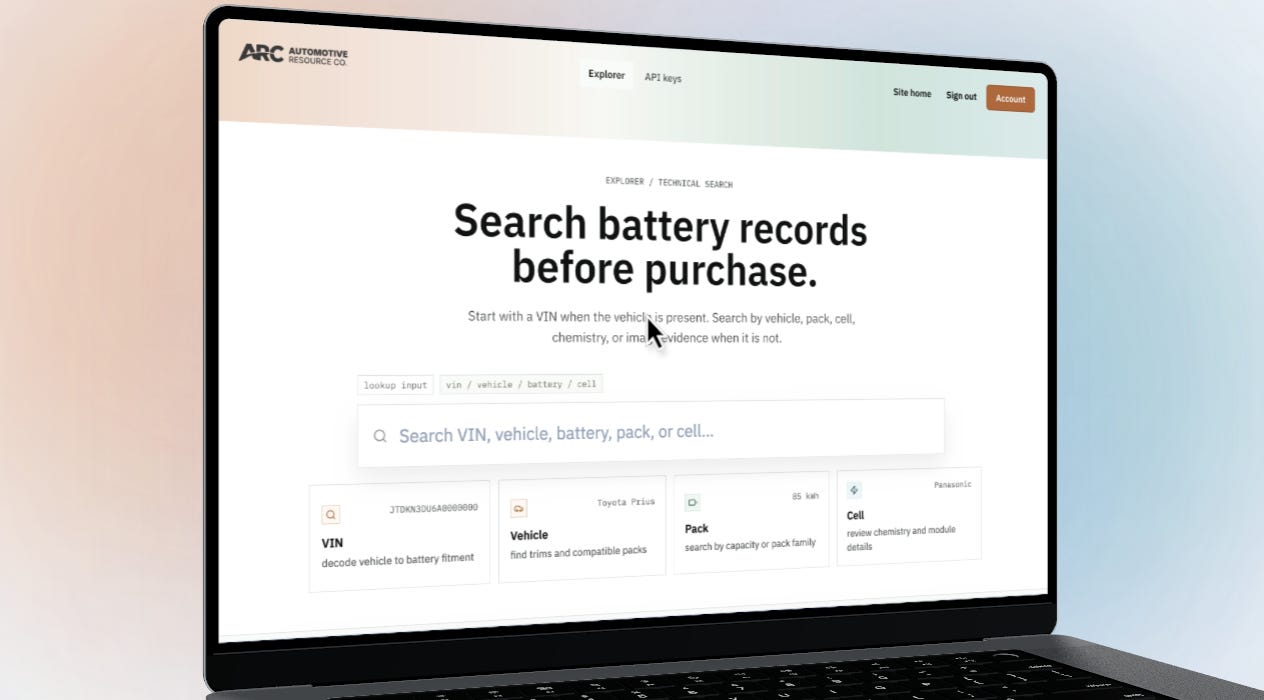
ARC has added a capability called Market Signal, which combines observed market listing data with the technical battery record. This is important because the used battery market is notoriously opaque, with pricing varying widely by chemistry, format, condition, and buyer. Most operators gather information from fragmented sources. By providing aggregated listing ranges alongside the technical record, ARC gives operators a single workspace where engineering data and market context come together. The company sees this as evidence to inform commercial judgment, rather than a substitute for it.
Together, Explorer and Market Signal show what an intelligence layer does in practice: it reduces information asymmetry, making battery transactions faster, less risky, and more efficient. It also gives the market a shared data foundation to route batteries to their highest-value next use. This foundation makes marketplace transactions more reliable, as buyers and sellers arrive with shared technical context rather than negotiating from scratch.
ReBattery
ReBattery is a London-based company that builds the marketplace layer of the battery stack—the infrastructure that turns valuation and routing decisions into completed transactions.7 The company has a global network of certified recyclers and second-life buyers and is expanding across the UK and EU in 2026. ReBattery’s main insight is that the battery circular economy has a problem with closing deals: even when a battery owner knows what they have and its value, finding a verified buyer, negotiating terms, handling compliance documents, and arranging hazardous materials logistics typically takes two to three months of emails, calls, and manual quotes. ReBattery reduces this process to just a few days.
The platform works by taking battery inventory and delivering a completed, compliant transaction. Operators can upload battery listings in under 60 seconds, and ReBattery classifies the assets and matches them with verified recyclers or second-life buyers based on chemistry, capacity, and format. The platform then manages the entire workflow in one dashboard, including competitive quotes, compliance documents, contracts, payment processing, logistics, and recycling confirmation. This means battery owners no longer have to navigate a fragmented market manually, as the platform finds the right buyer and handles the transaction.
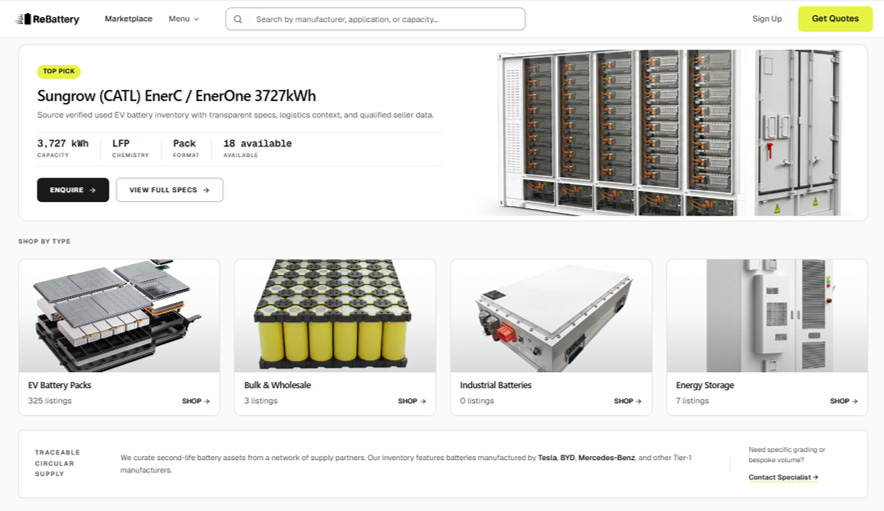
ReBattery also solves a key problem for buyers: confidence. Buying end-of-life batteries can be risky when condition data is missing or unreliable. ReBattery provides State of Health and usage history for each listing, giving buyers the information they need to make decisions without relying on physical inspections. For second-life buyers looking for industrial-grade hardware, the platform offers access to supply from leading OEMs, vetted through a professional network.
The marketplace layer is where the value of identity and intelligence is ultimately realized. Without Valtera’s chain-of-custody records and ARC’s technical and market data, ReBattery’s matching and compliance workflows would depend on buyers and sellers resolving information gaps themselves—a slow and costly process. With those layers in place, the transaction infrastructure can operate at the speed and reliability the market requires.
A Concrete Example: End-to-End Flow
To see how the stack works in practice, consider a damaged EV arriving at a tow yard.
Valtera logs the battery at intake, creating a chain-of-custody record that tracks custody transitions, storage duration, and condition. Without this step, the battery enters the downstream market as an unknown asset—its history unverifiable and its handling undocumented, forcing every subsequent party to start from scratch.
ARC uses the VIN to identify the battery pack and cells, then provides State of Health estimates and market price ranges via Explorer and Market Signal. Without this layer, the dismantler would rely on guesswork or time-consuming manual research to determine what the battery is worth and where it should go—introducing pricing risk and likely routing it to a lower-value use.
ReBattery matches the battery with verified buyers, obtains competitive quotes, handles compliance and logistics, and closes the transaction within days rather than months. Without the marketplace layer, the seller would face weeks of bilateral outreach, fragmented documentation, and uncertain logistics—the slow, costly process that has historically constrained circular outcomes.
Together, these three steps transform what was once a fragmented, opaque process into a coordinated, data-driven workflow that recovers more value in less time.
Conclusion
Valtera, ARC, and ReBattery illustrate the digital tech stack being built for batteries. Each company addresses a different challenge in the battery lifecycle—identity, decision-making, and transaction execution. Their combined effect is to reduce the friction and information gaps that have historically constrained circular outcomes. Batteries move from being opaque, difficult-to-value components that can be hard to manage safely to assets with persistent identity, interpretable data, and clear market pathways.
In that sense, the circular tech stack is doing for batteries what digital infrastructure has done in other industries: transforming fragmented, relationship-driven processes into coordinated, data-driven markets with faster price discovery and higher asset utilization. The companies profiled here are early stage, but they point to a clear direction. As electrification scales and large and small battery volumes reach into the millions, the winners in circularity will not be defined by physical capacity alone, but by who can most effectively turn data into coordinated, informed and safe circular markets.
Sources
