
The Tech Stack Powering Smartphone Recommerce


Smartphone recommerce has become a large-scale, data-driven industry. As trade-in programs, refurbishers, and wholesalers have expanded, a major challenge has been the ability to quickly and reliably test, data wipe, grade, and certify them at scale. At the same time, platforms like Amazon Renewed, eBay Refurbished, Back Market, Walmart, and carrier/OEM programs have raised their standards for functionality, data security, and condition accuracy, making diagnostics and secure erasure essential requirements rather than optional best practices.
In response, a specialized technology stack has emerged between device intake and online listing. Vendors like Blancco, PhoneCheck, NSYS, BlackBelt, ICEQ, Apkudo, and FutureDial now provide the core infrastructure for high-volume smartphone processing: automated hardware tests, certified data wiping, IMEI and lock checks, AI-assisted grading, and tightly managed warehouse workflows. These services enable operators to process hundreds of devices per hour per line while generating digital evidence - logs, certificates, and condition reports.
This article examines how the tech stack works: which diagnostic capabilities are now available, how leading tools implement them, and how their outputs meet the rules and expectations of major resale marketplaces.
The tech stack for smartphones
A growing ecosystem of specialist vendors has formed a “tech stack” for smartphone diagnostics and preparation for resale. The tech stack covers hardware testing, secure data erasure, automated grading, workflow orchestration, and analytics across high-volume secondary market operations. At the core, services like Blancco, PhoneCheck, NSYS, BlackBelt, and ICEQ provide broad functional diagnostics for display, battery, camera, audio, sensors, and biometrics, combined with certified data erasure and IMEI/lock checks.
This allows devices to be tested, wiped, and cleared for resale with documented results and audit trails. These tools typically support device processing in parallel, standardize scripted test flows, and generate detailed certification or history reports that marketplaces and buy-back programs increasingly treat as proof of condition and authenticity, directly supporting higher resale value and lower return rates.
In addition, vendors like Apkudo and FutureDial provide automation, AI-driven testing, and cosmetic grading, turning raw diagnostics into consistent grades, routing decisions, and optimized pricing at industrial scale. Their systems orchestrate workflows across intake, testing, grading, repair, and disposition, minimizing human variation by using image-based grading, automated pass/fail criteria, and integration with logistics and warehouse systems. This ensures each device moves through the process with minimal manual touch. ICEQ’s warehouse-oriented engine combines diagnostics, security checks, and IMEI verification with multi-device handling, acting as a processing backbone that can be aligned with a recycler’s or refurbisher’s own operational rules.
Secure wipe and compliance are anchored by tools like Blancco and NSYS, which offer certified data erasure aligned with standards like ADISA and R2, producing erasure certificates that satisfy both corporate data-protection policies and regulatory expectations when devices exit enterprise environments. PhoneCheck, BlackBelt, and similar solutions extend this with integrated IMEI, blacklist, and activation-lock checks, plus device history reporting that addresses fraud risk and ensures phones are not lost, stolen, or financially encumbered before entering consumer channels. For trade-in and retail use cases, platforms like BlackBelt Trade-In and PhoneCheck certification connect these technical capabilities directly to front-end experiences, enabling automated valuation, standardized condition tiers, and consumer-facing reports that underpin listing on marketplaces like Rebello and Swappie.
Table 1. Smartphone Data Processing Service Providers
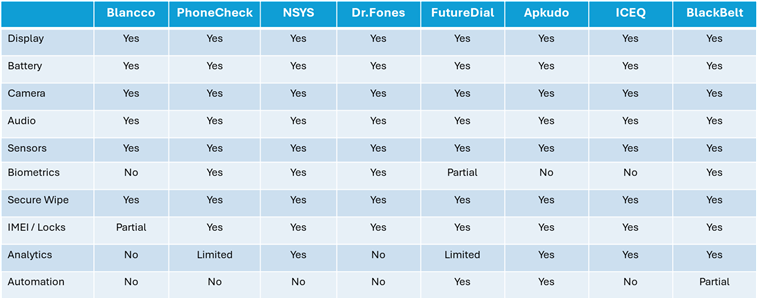
These diagnostic capabilities together let organizations reliably grade, value, and prepare smartphones for resale by ensuring functional quality, data security, and process efficiency. Display diagnostics verify that the screen has no major defects and functions correctly for end-users, checking for dead or stuck pixels, color accuracy, brightness, backlight uniformity, touch responsiveness, and visible artifacts like burn-in. Battery analysis focuses on remaining health and expected lifespan, comparing design versus actual capacity, measuring charge cycle count and maximum charge, and looking for abnormal drain or overheating during use or charging.
Camera testing ensures photo and video features meet buyer expectations by validating front and rear camera activation, autofocus and exposure behavior, image sharpness and color fidelity, low-light performance, flash operation, and video recording and playback stability. Audio diagnostics confirm communication and media playback quality through checks of loudspeaker and earpiece output, microphone capture quality, headphone or port-based audio paths, distortion and noise levels, and in-call audio behavior.
Sensor testing validates everyday functions that rely on hardware like the accelerometer, gyroscope, proximity and ambient light sensors, magnetometer, GPS, barometer, NFC, Bluetooth, Wi-Fi radios, and vibration motor, ensuring the device behaves as expected across motion, orientation, connectivity, and interaction scenarios.
Biometric checks verify that secure and convenient access will work for the next user by testing fingerprint readers, facial recognition, or other biometric systems, accurate matching, and reliable unlocking under normal use conditions.
Secure wipe capabilities ensure that all user data is irreversibly removed before resale by restoring the device to a fresh state, securely erasing user partitions, generating verifiable logs or certificates of erasure, and aligning with privacy and data protection requirements. IMEI and lock checks protect compliance and resale viability by reading device identifiers like IMEI and serial numbers, querying blacklist or lost-stolen databases, verifying SIM or network lock status, and confirming the presence or removal of account and activation locks.
Analytics capabilities turn these individual tests into operational insight, logging test and wipe results in structured form, producing failure statistics, tracking throughput and yield, and feeding this data into ERP, WMS, or pricing systems to optimize processes and decision-making. Finally, automation reduces handling time and variability in high-volume operations through scripted or guided test flows, automatic grading rules, bulk processing of multiple devices in parallel, label or asset tag generation, and API-driven integration so that diagnostic outcomes can automatically trigger routing, pricing, or disposition actions.
For high‑volume, scripted use in professional environments, these systems typically process on the order of a few dozen to low‑hundreds of phones per hour per line, depending heavily on workflow design and test depth.
Under realistic, mixed test + erase + grading conditions, many operators report throughputs around 30–60 devices per hour per station, especially where devices are tested and wiped in parallel batches. With strong automation (e.g., Apkudo, FutureDial) and optimized conveyor or rack setups, it is possible to reach or exceed roughly 100+ devices per hour per processing line, but this assumes shortened test profiles, minimal exception handling, and high operator discipline.
Digital Marketplaces
Digital marketplaces now sit at the center of the smartphone resale chain. They connect millions of sellers and buyers, providing the trust, pricing transparency, and transaction rails that make recommerce economically viable at scale. They aggregate fragmented supply from trade‑in programs, refurbishers, repair shops, and individuals, then normalize it through standardized product categories, condition grades, warranties, and buyer protections so used devices can be compared and purchased as easily as new ones.
These platforms also set the practical “rules of the game” for quality and compliance by defining what counts as refurbished, what condition tiers mean, and what documentation is required around testing, data wipe, and IMEI status. Programs like eBay Refurbished, Amazon Renewed, and Back Market’s Verified Refurbished use grading schemes, warranty requirements, and approved testing practices to push refurbishers toward consistent diagnostics and secure erasure, which in turn reduces returns and builds buyer confidence.
Most large marketplaces share a common requirement: sellers must ensure devices are fully functional, data-clean, unlocked, accurately graded, and consistently represented, with differences mainly in how explicit they are about diagnostics and which tech stack they trust as proof.
Amazon Renewed has the clearest written requirements, demanding full functional diagnostics via external software, complete forensic data destruction, factory reset, documented IMEI checks, and auditability for at least 120 days.1 Devices must be fully functional, non-blacklisted, data-wiped, and graded to Amazon’s condition tiers, where quality failures trigger program risk and extra fees. Platforms like Blancco, NSYS, PhoneCheck, and BlackBelt meet these requirements because they combine scripted multi-point hardware diagnostics, certified data erasure with logs, and IMEI/lock checks plus exportable reports. NSYS explicitly markets Amazon Renewed alignment through multi-test diagnostics, AI auto-grading, data erasure, and certificates that aid audits, while Blancco excels in formal compliance and forensic-grade logging, and PhoneCheck with BlackBelt provide single “diagnostics + certificate” artifacts for Renewed workflows.
For core eBay “used” listings, policy takes precedence over prescribed tooling. Devices must be accurately described, not activation-locked, and compliant with local law, without mandating specific diagnostic software.2 However, eBay Refurbished requires manufacturer-level refurb standards and evidence of professional inspection, testing, and refurbishment from approved partners. PhoneCheck anchors this as the official certification partner for eBay Refurbished smartphones, delivering an 80-point diagnostic script, ADISA-certified data wipe, and buyer-referenceable device history reports, making it the most natively aligned platform. Blancco, NSYS, and BlackBelt serve as valuable back-end tools, with PhoneCheck handling the visible certification layer eBay recognizes.
Back Market emphasizes strict functional quality and consistent grading over naming one mandatory tool, explicitly requiring in-depth diagnostics, clean IMEI, reliable battery health, and onboarding audits of refurbishers.3 It maintains an “approved testing software” list, publicly naming Piceasoft and PhoneCheck as preferred for Verified Refurbished due to their diagnostics, secure erasure, and detailed reports. NSYS and BlackBelt fit expectations well with multi-point diagnostics, AI/rule-based grading, and certificates that export QC/grade data Back Market demands, while Apkudo and FutureDial operate behind the scenes supporting carriers, OEM trade-in partners, converting high-volume test and cosmetic grading into enforced condition tiers.
Walmart Restored demands “excellent technical condition” with no dead pixels on displays, battery health ≥80%, factory reset, latest firmware support, and full unlock, without prescribing a diagnostics brand.4 Any major diagnostic/erasure platform can satisfy this, though the best fits expose battery-health thresholds, test display pixel defects and cosmetics, and output SKU-tied logs. FutureDial and Apkudo stand out for large Walmart suppliers via conveyor-line automation, grading engines, and WMS/ERP integration suited to retail supply-chain scale.
Swappa operates seller-driven with transparent, strict rules: devices must be fully functional without cracked/chipped glass or structural damage, feature clean ESN/IMEI ready for activation, and avoid financed, leased, blacklisted, or activation-locked status.5 Swappa runs its own ESN/IMEI checks and offers a free checker, but mandates no particular tools. For volume sellers, PhoneCheck, NSYS, and BlackBelt align neatly by bundling full functional scripts, IMEI/ESN checks with blacklist/lock status, and simple printable/PDF reports for disputes, while Blancco handles secure-wipe/compliance behind the scenes, with visible value in “clean IMEI + proof of tests” over formal certifications.
Gazelle functions as a direct recommerce brand rather than an open marketplace, publishing less on its toolchain but guaranteeing fully functional, inspected, tested, data-wiped devices with clear cosmetic grading and warranty support, emphasizing functionality and data safety over specific brands.6 At its scale, players like Gazelle rely on high-throughput automation and enterprise-grade erasure via combinations like Blancco or NSYS for compliant wipe and IMEI/lock checks, plus PhoneCheck, Apkudo, FutureDial, or BlackBelt for diagnostics, grading, and valuation; Apkudo and FutureDial particularly appeal by optimizing full secondary-device processing flows to match needs for predictable grading and pricing at volume.
Conclusion
The modern smartphone resale industry is characterized by a growing sophistication in the technology that sits between device intake and the point of sale. Manual technician work has been replaced by a tightly integrated pipeline of diagnostics, secure erasure, grading, orchestration, and analytics. This transforms chaotic streams of traded-in phones into standardized, certifiable retail products. Automated hardware tests cover a wide range of components, from display, battery, and camera to audio, sensors, biometrics, connectivity, and digital locking mechanisms. Certified data-wipe engines ensure that every device leaves enterprise or consumer hands with verifiable, irreversible erasure and a clean IMEI status.
On top of this diagnostic and erasure layer, AI-driven grading and workflow engines convert raw test results into consistent condition tiers, pricing decisions, and routing logic that can handle high warehouse volumes. These systems coordinate intake, testing, repair, and disposition with image-based cosmetic grading, automated pass/fail criteria, and deep integration into warehouse management, enterprise resource planning, and pricing tools. This allows each device to move through racks, conveyors, and workstations with minimal manual intervention.
The same technology stack generates certificates, logs, and device histories that marketplaces and enterprise buyers increasingly require as proof of quality and compliance. These capabilities enable seamless listing and sale across various platforms, including Amazon Renewed, eBay Refurbished, Back Market, Walmart programs, carrier/OEM trade-in channels, and brick-and-mortar retail.