
Is Vinted Walking into a Competitive Buzzsaw?
A look at Vinted's plans to expand recommerce operations in the United States


This month, Vinted announced that it was expanding its operations into the United States. The rollout will begin in New York. A multi-year push will commit tens of millions of dollars to brand awareness campaigns, app/platform optimizations for US logistics and preferences, expanded sales channels, and infrastructure for coast-to-coast scaling. Senior executives frame it as transforming secondhand from niche to default. Vinted’s CEO Adam Jay stated: “We’re on a mission to make second-hand the first choice, because we know there’s huge value in what’s sitting at the bottom of closets across the country.”1
Will Vinted’s gamble in the US pay off? There are at least 24 resale platforms operating in the US across apparel, luxury fashion, and general merchandise categories. These platforms encompass both public corporations and private marketplaces employing a wide array of business models, including peer-to-peer marketplaces focused on apparel and luxury fashion, large general marketplaces supporting auctions and broad resale across all categories, and hybrid operations that blend owned inventory with consignment sales.
This broad spectrum of models highlights a maturing secondhand sector where competitive intensity correlates with factors like market scale, inventory management, and social engagement features. In short, Vinted faces a thicket of competitors.
A Foundation of Success
Vinted is a circular economy success story. The Lithuania-founded peer-to-peer recommerce platform launched in 2008 by Milda Mitkutė and Justas Janauskas as a classifieds site for kids’ clothes.2 It pioneered C2C resale by solving trust and logistics hurdles through buyer-paid fees (3-8%), no seller charges, and innovations like Vinted Inbox (secure messaging), Offer to Buy, and bundle discounts.3
The platform's history includes several key milestones. From 2008 to 2014, Vinted started in Lithuania and then expanded to France, the UK, and Germany, which helped it reach 10 million users by 2014. Between 2016 and 2019, the company raised €130M in Series B funding to launch in the Benelux countries, Spain, and Italy, and introduced Vinted Shipping for labels. From 2020 to 2023, the pandemic fueled 5x growth, reaching 80M users, with €590M in funding at a €4.5B valuation. During this time, Vinted added Vinted Go for logistics and Vinted Pay, and acquired Rebelle, a luxury brand. From 2024 to 2025, the platform expanded into the Nordics and electronics, surpassing 100M registered users, €10B+ in GMV, and €1B+ in revenue, becoming France's #1 clothing retailer by volume.
From a strategy perspective, Vinted’s success is impressive. Not only did it overcome the classic platform chicken-and-egg dilemma, it did so in the peer-to-peer resale market, where margins are notoriously thin. The company bootstrapped supply from price-sensitive casual sellers via zero listing/seller fees, which rapidly grew inventory to 1B+ listings and lured Gen Z buyers through viral social discovery and bargains, igniting self-reinforcing network effects across Europe’s fragmented markets. This asymmetric pricing (3-8% buyer protection fee covering shipping/insurance) maximized liquidity without eroding seller margins. This helped to achieve strong repeat rates among users.4 In the process, the platform grew to become Europe’s dominant secondhand marketplace for fashion and beyond, with 2,500+ employees operating across 20+ countries.
US Market
The market conditions in the US are quite different. Unlike Europe, where Vinted successfully navigated a patchwork of jurisdictions across 20+ countries with varying regulations, languages, and norms around thrift, the US is a large, more unified national market. There are also more entrenched competitors.
It is often assumed that Europe is ahead when it comes to circular platforms. This is far from the case. The US is home to at least 24 secondary resale marketplaces; some, such as eBay, were founded long before Vinted launched in Europe. From a competitive standpoint, some of these platforms pose more of a threat than others to Vinted based on factors like scale, P2P similarity, social features, inventory control, and market overlap. It is therefore useful to group these platforms by the competitive challenge that they present as shown in this graphic.
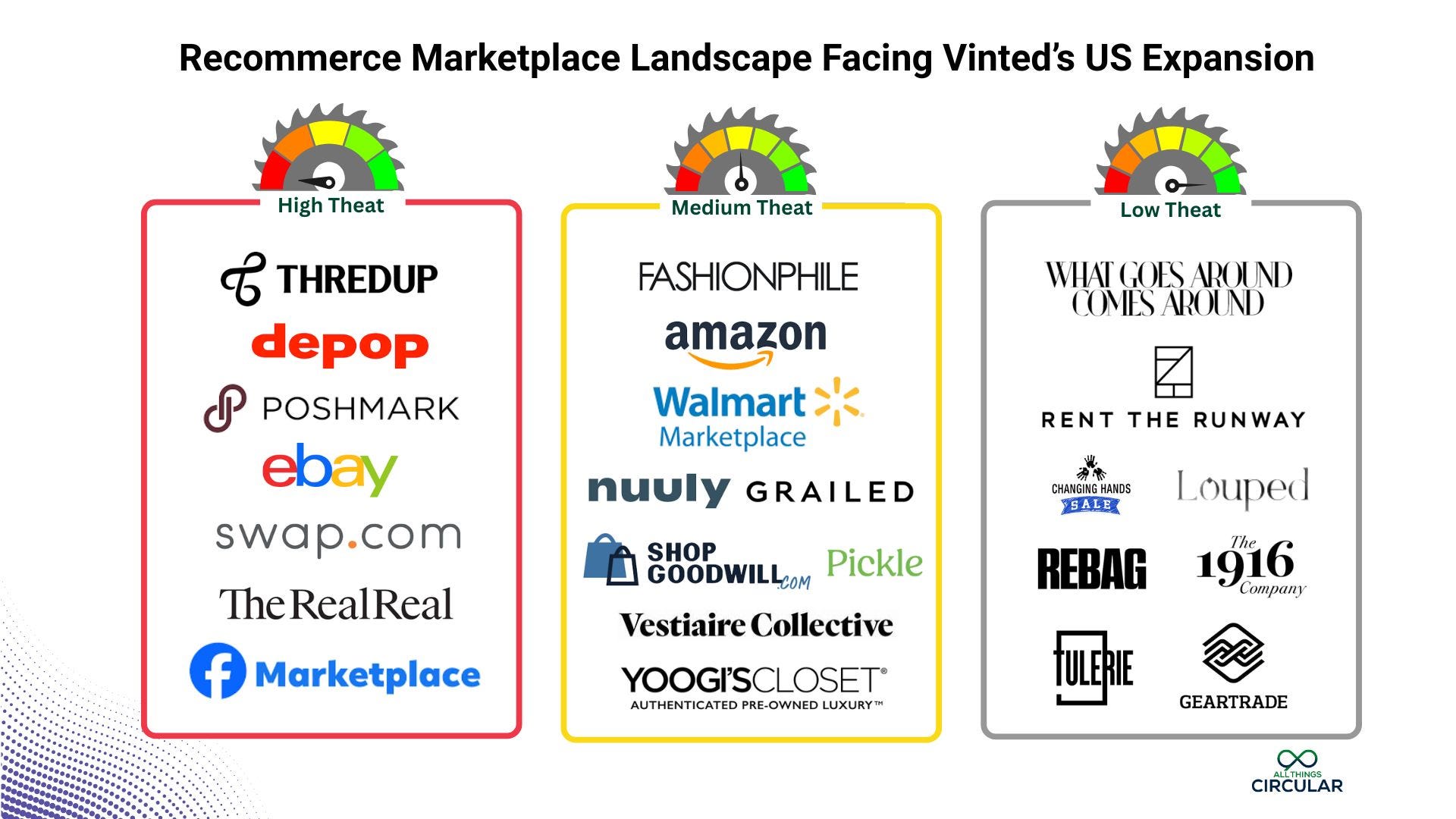
High-threat
The seven resale marketplaces that may pose the strongest competitive challenges to Vinted in the US are ThredUP, Poshmark, RealReal, eBay, Swap.com, Facebook Marketplace, and Depop. These resale marketplaces have traits such as large user bases, focus on fashion, social or peer-to-peer dynamics, and efficient consignment processes that give them access to supply at scale.
ThredUP leads in consignment, processing over 100,000 items daily, and allows brands to mail in clothes for inspection and resale. It uses AI pricing and maintains a clean inventory to attract premium buyers, generating $256M in revenue despite ongoing losses, which highlights its scale advantage over peer-to-peer platforms.
Poshmark thrives as a social peer-to-peer fashion resale app, with over 100 million items listed, and features like live “Posh Parties” and instant labels. It targets Gen Z and vintage shoppers with a model similar to Vinted but is hindered by higher costs and recent updates to seller tools in 2026, which faced backlash.
RealReal, a public luxury consignment specialist, employs experts to authenticate and resell high-end fashion and handbags, with consignors receiving 50-70% of the sale price. This drives over $500M in gross merchandise value, attracting affluent customers and challenging Vinted’s expansion into luxury.
eBay is the OG in the resale space with a dominant auction and fixed-price platform with strong fashion categories, serving millions of US. In recent years, the company has doubled down on its circular economy strategy including a focus on fashion.5 This makes it a go-to alternative for many serious sellers.
Facebook Marketplace offers free local peer-to-peer listings integrated with Meta’s billions of users, competing on zero fees and convenience, but lacks Vinted’s shipping and social features.
Depop targets Gen Z through TikTok-driven peer-to-peer fashion, focusing on vintage and streetwear, with 35M US users and zero seller fees, as buyers pay for shipping. With a major push in the US in 2026 focused on “Edited Self” trends, Depop, as an Etsy-owned platform, is the fastest-growing direct rival to Vinted’s youth demographic.
Swap.com operates as an online consignment service, not peer-to-peer, where sellers mail in items for professional photography, pricing, and listing across various categories like women’s, men’s, and kids’ clothes, toys, and books. It handles sales and shipping, paying consignors 20-80% through a SureSell guarantee, which appeals to those who want to declutter hassle-free but may deter high-volume sellers due to lower payouts.
Medium-threat
The nine resale marketplaces that pose a medium competitive threat to Vinted in the US, as listed in the attached table, use a mix of models like owned inventory, consignment, subscriptions, and seller fulfillment. This challenges Vinted’s focus on peer-to-peer apparel sales through their niche strengths, scale, or convenience, often with fees or limited selection.
Fashionphile specializes in luxury resale of handbags and accessories, owning its inventory and offering authentication, buy, sell, and consign options with low fees of 15-30% for high-end items over $1,000. It attracts affluent shoppers with its professional presentation and stores in Beverly Hills, San Francisco, and New York City.
Nuuly, a subsidiary of Urban Outfitters, offers apparel subscription rentals with resale options, allowing users to keep, swap, or buy used items for $98/month. It competes by offering access over ownership, targeting fashion-forward users with unlimited swaps.
Vestiaire Collective, a Paris-based luxury resale platform, acquired Tradesy—a U.S. company founded in 2009 and headquartered in Santa Monica, California—in March 2022 (announced March 15), merging communities to reach 23 million members and over $1 billion in GMV. Tradesy ceased independent operations by early 2023, with its platform shut down and users migrated to Vestiaire, which now maintains a strong U.S. presence via its main site, a Brooklyn authentication center, and New York offices.
Yoogi’s Closet is a private online consignment platform for luxury women’s fashion and handbags, authenticating items for maximum exposure and seller payouts of up to 70%. It emphasizes trusted pre-owned designer pieces.
Amazon Resale, available through dedicated storefronts and Amazon Warehouse Deals lets third-party sellers list pre-owned, used-like-new, or refurbished apparel to over 2 billion monthly visitors, with the added benefit of FBA's logistics. Initially launched as a hub for discounted open-box and returned fashion items, such as Levi's jeans for $13 used versus $96 new, it uses AI grading and repackaging services, as well as Renewed guarantees, to resell customer returns as "Used - Like New" after refurbishment, recovering value and attracting budget-conscious shoppers who want fast Prime delivery without the hassle of peer-to-peer transactions.
Walmart Marketplace, also a public and general platform, supports the resale of pre-owned items with fulfillment services, attracting price-sensitive shoppers with its over 100 million monthly visitors and low barriers.
ShopGoodwill.com, a private, large general platform, curates online thrift store items from nonprofit donations, offering apparel auctions with proceeds funding programs. It blends affordability with mission-driven appeal.
Grailed operates as a private peer-to-peer platform for menswear and streetwear resale, with bidding and fixed-price options, expert curation, and a community focus. It has carved out a loyal niche among male fashion enthusiasts. These platforms erode Vinted’s competitive edges in luxury, convenience, and general resale without fully matching its social peer-to-peer virality.
Changing Hands is a private thrift store chain with physical locations and online sales, combining in-person apparel browsing with e-commerce. It appeals to local bargain hunters but lacks the scale of national peer-to-peer platforms.
Pickel is a private apparel resale player with limited public information, presumed to focus on fashion listings similar to niche peer-to-peer platforms but without broad visibility.
Low-threat
There are eight other resale marketplaces that do not pose a significant competitive threat to Vinted. They specialize in niche areas like luxury consignment, rentals, or gear resale, with limited overlap with Vinted’s focus on peer-to-peer apparel. This limits their scale, user base, and transaction models.
The 1916 Company, a private luxury fashion company, offers consignment services for authenticated pre-owned luxury items like watches, jewelry, and handbags from brands like Hermès, Chanel, and LV. It targets collectors and has revenue of over $600M, but its appeal is limited to the high-end market.
Louped, another private luxury fashion company, operates a multi-vendor marketplace for luxury jewelry, focusing on high-end pieces rather than volume apparel sales.
Rebag, also private and focused on luxury fashion, specializes in consignment resale of luxury handbags, offering instant offers and authentication, but it does not cater to general fashion needs.
Rent the Runway, a private apparel company, leads in subscription rentals with unlimited swaps for $98/month, but its resale aspect is limited, and it competes through designer access rather than secondhand sales.
Tulerie, a private apparel company, allows peer-to-peer rentals of designer clothing and accessories, making money from temporary use for events, rather than permanent resale.
What Goes Around Comes Around, a private apparel company, curates luxury consignment retail and online stores for vintage and high-end fashion, combining physical and online stores for collectors, not the mass market.
GearTrade, a private company, specializes in peer-to-peer resale of outdoor gear like ski, bike, and camp equipment, targeting adventure enthusiasts with little overlap into apparel.
These companies segment the market into rentals, ultra-luxury accessories, and gear, leaving room for Vinted to focus on general fashion peer-to-peer sales.
Indirect Threats
Vinted also faces indirect threats. Companies like Trove, Archive, and Treet offer Resale-as-a-Service (RaaS), which lets brands control secondhand supply before it reaches independent marketplaces like Vinted. This could throw a wrench into Vinted’s US plans because it reduces the inventory available on these marketplaces and helps brands keep their customers loyal. These companies provide a complete service to brands, including trade-ins, authentication, resale stores, recycling, and repairs, and have partnered with many well-known brands, such as Trove with Patagonia and Levi’s.
These RaaS companies manage the whole process of recycling and reselling products, from collecting returns and excess stock to refurbishing and reselling them through brand websites or in-store kiosks.6 They use AI to set prices and often combine elements of peer-to-peer sales with centralized control, which helps them keep customer data and increase sales while also improving their environmental and social record. This means that resale is moving away from open marketplaces and towards “walled gardens” where brands actively manage the selling and reselling of their own products and keep customers loyal to them.
Vinted has to compete with over 150 US brands that are using RaaS models, including Lululemon, Gap and Canada Goose.7 These branded resale programs reduce the supply of products that might otherwise be sold on Vinted. When customers can buy secondhand products directly from the brand, they are less likely to look for bargains on Vinted.
RaaS companies are constantly innovating, as seen in Trove’s 2025 Plugin Suite.8 This suite of tools allows brands to easily add resale, trade-in, recycling, and repair options to their websites, which helps them increase sales and reduce waste. The plugins work seamlessly with the brand’s website, allowing customers to trade in products at checkout, and help brands launch their resale programs much faster. This makes it harder for Vinted to compete, as more brands are able to manage their own resale programs and keep customers loyal to them.
Conclusion
Vinted overcame the chicken-and-egg problem that challenges many platforms, driving its European growth with zero seller fees and strong network effects. The US resale market, however, is a tougher test with two dozen established players, of which at least seven will be formibable. Vinted will have to repeat the process of attracting new supply from sellers, win over customers from existing platforms, or successfully attract those not yet engaged in recommerce. Its fee-free model and tools like Vinted Go and Vinted Pay fueled rapid growth in Europe were it benefited from first mover advantage and less competition.
Still, Vinted’s proven playbook may equip it to bring circular network effects to urban hubs like New York and overcome entrenched players and entice new users.
If Vinted succeeds in the United States, it will certainly be a landmark circular economy success story.

