
Digital Product Passport Rollout: Readiness Matrix for OEMs, ITADs, and Marketplaces


This is a crucial year for Digital Product Passports (DPPs) as they transition from planning to implementation. The European Union’s regulatory framework for batteries will come into effect in 2026, with textiles and apparel as well as consumer electronics following in 2027-28. This will lead to more companies setting up dedicated DPP teams to focus on analysis, strategy and implementation. Standards bodies like GS1, CIRPASS, and associations like GSMA will launch programs to facilitate industry discussions on data protocols, technology and interoperability.
As activity increases, it will become clear which companies are truly ready for DPPs. Some companies will emerge as leaders in DPP adoption, while others will struggle to keep up.
In this article, I present a DPP Readiness Matrix, which examines key factors that determine a company’s preparedness for DPPs and the implications for their business. In the electronics industry, we can expect to see the level of preparedness to range widely across OEM, telecoms, ITADs, data asset managers, refurbishers and marketplaces. Which companies are best positioned to move to the frontier and become Circular Leaders may come as a surprise.
Regulatory Milestones
EU DPP regulations under the Ecodesign for Sustainable Products Regulation (ESPR) follow a phased rollout via the 2025-2030 Working Plan.1 The phased rollout will prioritize high-impact sectors through delegated acts that specify DPP data requirements, timelines, and enforcement. The process will start with batteries in 2026 and expanding sector-by-sector to allow adaptation while building shared infrastructure like the central registry. The central registry is mandated by the Ecodesign for Sustainable Products Regulation (ESPR), which requires the Commission to set up an EU‑level system for registering DPP product identifiers and enabling market surveillance and customs checks. It is an EU‑run IT backbone that stores and validates product identifiers and links to passports, not the full DPP data itself.
Electronics ranks as a Wave 2 priority under ESPR, following batteries, due to high e-waste volumes and multi-tier bills of materials (BOMs) demanding data on components, energy efficiency, and recyclability. There are phased mandates for ICT/consumer products (smartphones, servers, appliances) focusing on repair scores, recycled content, and unit-level traceability from Q2 2025 pilots to 2027-2028 full rollout. Electronics DPPs must provide structured, machine-readable data via data carriers (QR, NFC, RFID) linked to GS1 identifiers, covering baseline ESPR requirements plus sector-specific elements like repairability for ICT/consumer products and state-of-health for batteries.2 Data requirements include public (consumer access), restricted (authorities), and dynamic (lifecycle updates), stored interoperably with 10-year retention.
Implementation by 2027 may seem a long way off but not for an industry the size and scale of the electronics industry. The rules will impact millions of electronic products. By 2027, approximately 20-30 million electronic products will require DPPs in the EU, driven primarily by the February 18, 2027 Battery Regulation mandate for all industrial (>2 kWh), EV, LMT (<25 kg), portable (≤5 kg), and SLI batteries placed on the market.3 This will cover ~5-10 million EV/industrial batteries plus tens of millions of portable/SLI batteries annually.4 Millions of additional devices will subsequently become subject to the DPP rules.
These mandates raise an important question for companies: Who will be ready and who will not?
Two key vectors will shape the degree of preparedness: technology readiness and engagement with governance bodies.
Technology Readiness
The technology underpinning DPPs is complex and diverse. There are two key groups of players. One set comprises what we can call cloud-based infrastructure providers. This includes the big tech companies like AWS, which offer flexible building blocks for custom DPP systems. The other set comprises companies building proprietary DPP products. There are at least 25 proprietary DPP providers that offer custom solutions.5 These companies provide turnkey solutions that are optimized for compliance. Analyzing these providers’ solutions reveals patterns in geography, maturity, and strategic focus. They differ in the geographies they serve, the sectors they focus on, and the technologies and data systems they use. They also vary in their time in the market. Some pioneers, like Circularise, TrusTrace, and Everledger have been providing tracking and tracing solutions since 2015-16. Other established companies, like Kezzler, Retraced, and Renoon have emerged since 2019. There are also newcomers, like Apkudo, Eviden, and Qliktag who announced DPP solutions beginning in 2024. See Table 1.
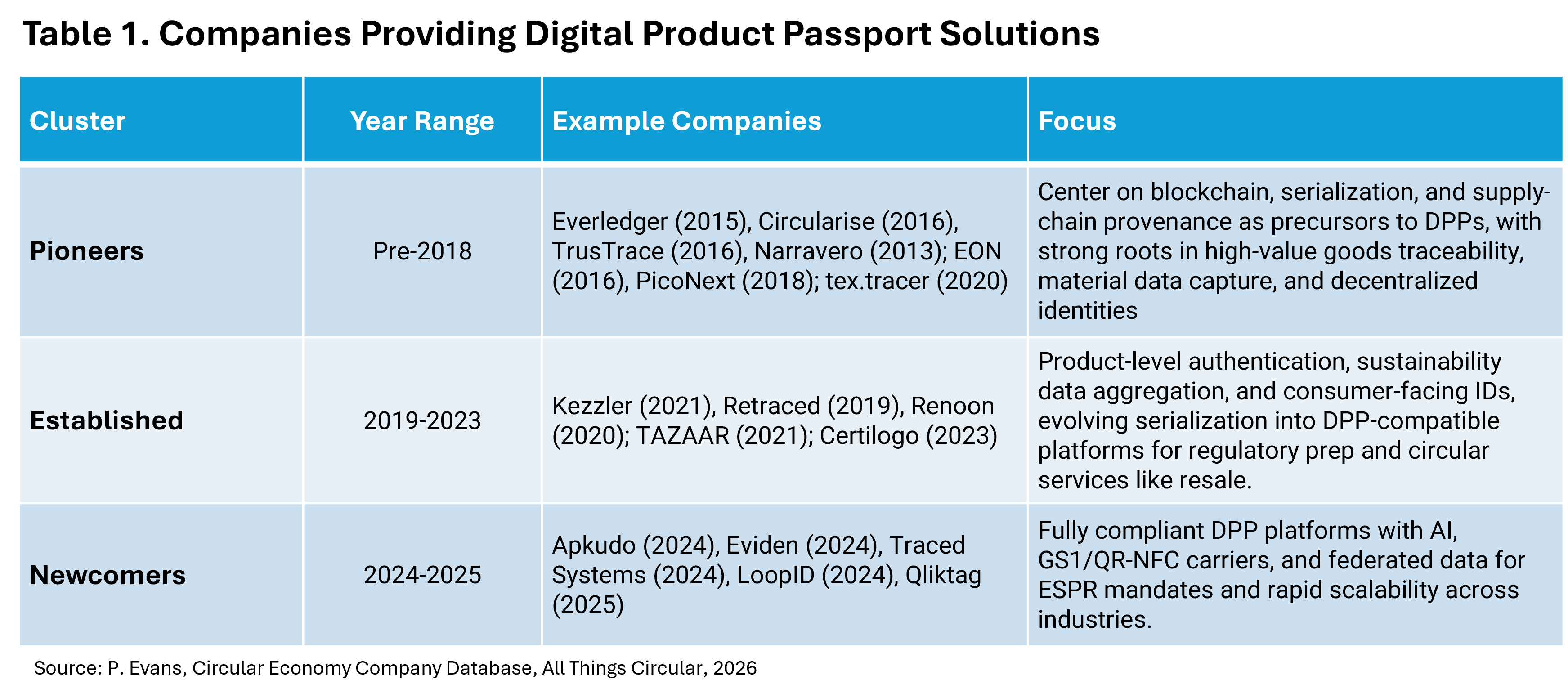
Electronics industry players, including OEMs, reverse logistics firms, ITADs, and marketplaces, must evaluate DPP solutions based on a variety of factors. These factors must consider compliance with ESPR mandates and optimize circular processes like takeback and resale. First, they need to consider standards compliance and interoperability, which requires support for GS1 EPCIS and Digital Link, as well as ESPR-mandated data templates for BOMs, SVHCs, and repair scores. This enables sharing data across the value chain. Equally important are data management and security features, such as AI-driven validation, blockchain or ZK-proofs for tamper-proof records, and adherence to ISO 27001/GDPR standards to protect sensitive product data.
Integration capabilities are also crucial, requiring API connections with ERP/PLM systems and flexible NFC/QR data carriers for efficient item scanning and resale verification. Providers must offer scalable and user-friendly solutions through cloud-hosted platforms that can handle high volumes of devices or networking gear. These platforms should have intuitive interfaces that are accessible to non-technical users. For takeback and resale optimization, solutions with dynamic valuation tools that leverage DPP usage data can boost remanufacturing yields and residuals by 20-30%. The potential to establish partner ecosystems that capture and record multiple events and owners over the life of a product are also important.
Governance Engagement
Electronics companies operate in a complex governance landscape that includes standards bodies, associations, and international organizations. The Global Electronics Council (GEC) and CEN/CENELEC JTC 24 are key players, with the latter defining standards for DPP interoperability, conformance testing, cryptographic attestation, data carriers, and secure exchange. These standards are expected to be in place by 2025 to ensure ESPR compliance across batteries and electronics.
The GSMA is a global organization that brings together the mobile ecosystem, representing over 750 mobile operators and nearly 400 other companies. It plays a central role in driving innovation, setting standards, and promoting connectivity. The GSMA’s experience with IMEI/TAC for device identity and data management can help bridge the gap between OEMs, operators, and recyclers.
GS1 is a not-for-profit international organization that develops and maintains global supply chain standards for the identification, capture, and sharing of information. It can play a major role in DPPs through the Global Trade Item Number (GTIN) and GS1 Digital Link standard, which turns traditional identifiers into web links. This allows stakeholders to access a wide range of digital information via a simple scan.
UN agencies, such as the United Nations Economic Commission for Europe (UNECE) and its subsidiary body, the UN Centre for Trade Facilitation and Electronic Business (UN/CEFACT), are also players. They support transparency, circularity, and informed consumer choices through instruments like the UN Transparency Protocol (UNTP) and collaboration with ISO.
Another initiative is CIRPASS, a European Commission-funded project preparing for the widespread adoption of DPPs to support the circular economy. CIRPASS united 31 partners—including industry leaders, researchers, standards bodies like GS1, and digital experts—to align DPP concepts with ESPR requirements, creating a cross-sectoral data model for stakeholder-specific data sharing (e.g., supply chain traceability, repair data for electronics). The initiative produced a DPP system architecture proposal emphasizing semantic interoperability, flexible data sharing, and consensus on product identification to support lifecycle transparency in electronics value chains.6
Companies must decide which of these organizations to engage with and what level of resources to allocate to this engagement. There are three distinct options: high engagement, passive observer, or complete disengagement. Each option carries trade-offs in resource allocation and influence. High engagement requires significant upfront investment but yields direct influence. Passive observer status involves monitoring public outputs with minimal cost, gaining awareness without commitment, but cedes agenda-setting and gaining valuable information early. Complete disengagement requires no resource outlay but invites adverse outcomes, such as standards misaligned with legacy systems, supplier conflicts, and even border rejections of product in the future. Companies that disengage risk facing fines and market exclusion, particularly after July 2026.
DPP Readiness Matrix
The DPP Readiness Matrix illustrates the potential position of companies across two axes—technology readiness and governance engagement. Table 2 illustrates four potential outcomes in a 2 x 2 matrix.
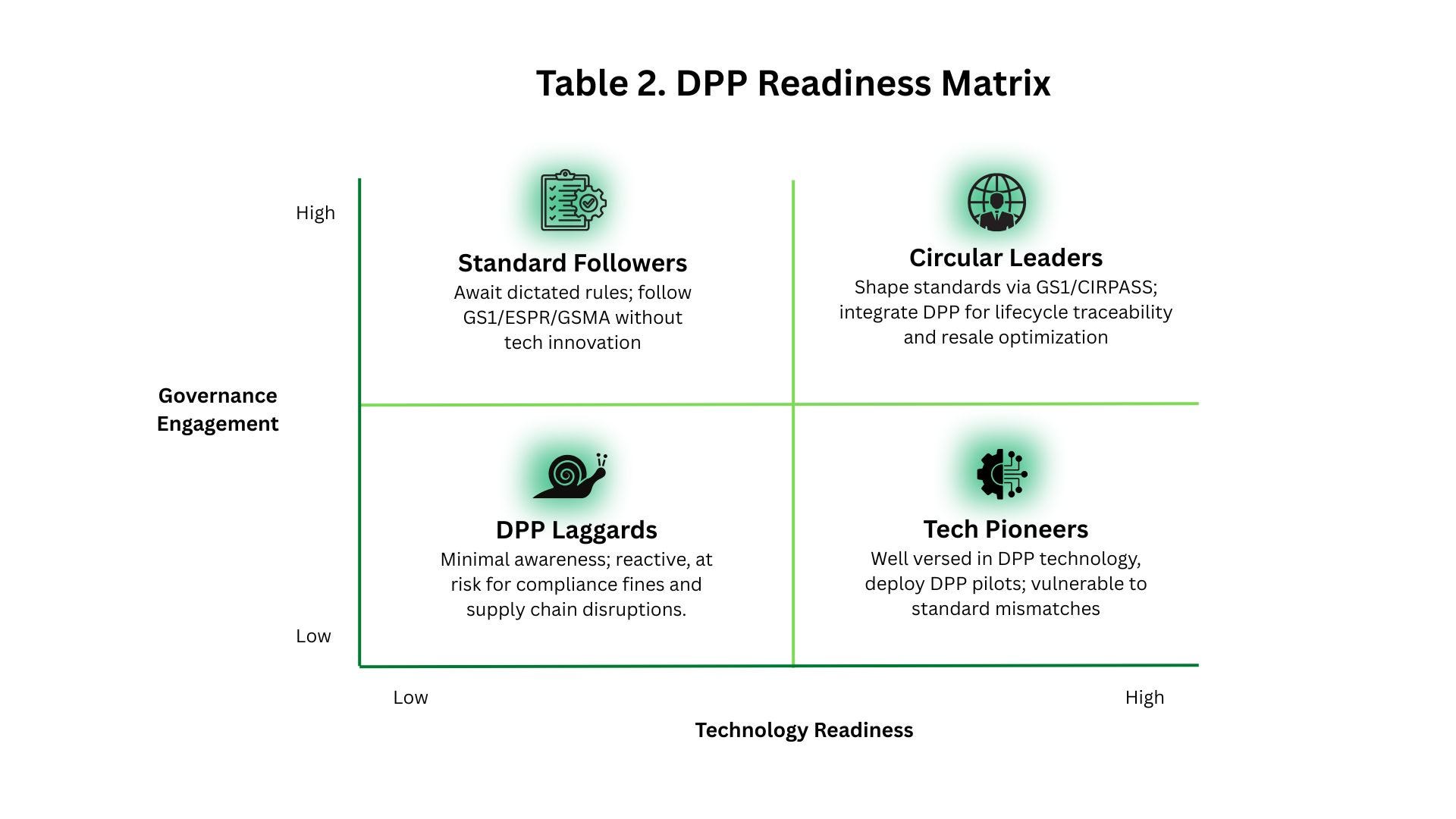
DPP Laggards (Low Tech, Low Governance) exhibit minimal DPP awareness, treating compliance as a distant regulatory checkbox. They face reactive scrambles post-July 2026 registry launch—lacking data infrastructure for BOMs, carbon footprints, or SoH—triggering border rejections, fines up to 4% turnover, and supplier conflicts as EU customs demand valid QR/NFC-linked passports.
Standard Followers (Low Tech, High Governance) actively track GS1 consultations and CEN/CENELEC JTC24 outputs, securing basic interoperability via public templates (e.g., PPWR for packaging). However, without proprietary tech like Apkudo-style AI grading or Protokol PIM integration, they remain compliance reporters—missing circular revenue from resale optimization that high-tech peers capture.
Tech Pioneers (High Tech, Low Governance) deploy internal pilots—QR/NFC data twins, blockchain BOMs, or AI-driven reverse logistics—gaining immediate speed in trade-ins and fraud reduction. Carriers and ITADs thrive here short-term, but risk costly rework when 2026 standards finalize (e.g., mandatory GS1 serialized GTINs), as proprietary systems clash with mandated schemas.
Circular Leaders (High Tech, High Governance) combine cutting-edge platforms with standards influence—joining GS1/CIRPASS pilots to embed business models into rules (OEM-controlled repair data, marketplace interoperability). They dictate terms via GSMA IMEI linkages and RAIN RFID scalability, unlocking lifecycle traceability, resale premiums, regulatory moats, and ecosystem dominance as DPP data fuels AI circularity by 2030.
Strategic Implications
The DPP Readiness Matrix highlights key strategic differences for companies in the electronics industry. DPP Laggards, characterized by low technology and low governance, face several real risks. After July 2026, for example, companies shipping batteries that are not in compliance can face border rejections for their products and fines of up to 4% of EU revenue.7 Standard Followers, with low technology but high governance, may achieve basic compliance but miss out on differentiation, remaining focused on reporting without leveraging optimized resale or reverse logistics benefits.
On the other hand, companies that fall into the category of DPP Tech Pioneers, who have high technology but low governance, develop strong technology capabilities but may overlook chances to influence standards. As a result, they may encounter mismatches between the technology solution they pick and the standards and protocols that govern DPP deployment. Finally, Circular Leaders, combining high technology and high governance engagement, may spend more resources but will be better positioned strategically. They are more likely to avoid technology and regulatory mismatches and gain greater foresight as how to leverage DPPs for competitive advantage.8
Conclusion
As 2026 unfolds, DPPs will likely get more attention from electronics companies. The DPP Readiness Matrix suggests that companies will respond in different ways. Some will become leaders in circular practices, while those who don’t invest will fall behind. It’s possible that OEMs won’t be the ones taking the lead. Other players further down the supply chain may be more active in adopting DPP technology for several reasons. The implications are significant: if early movers choose the wrong technology partners or standards bodies don’t make progress, they may invest without seeing benefits.
In 2026, making smart choices will be key to giving companies a real competitive advantage over those that are not making progress.
Where does your company map on the DPP Readiness Matrix?
Sources
All Things Circular, Circular Economy database, 2026.