

Live selling has already changed the way people shop online by making it a real-time, interactive experience. What started as a way to sell collectibles, beauty products, clothes, and jewelry is now moving into new areas. One of the most consequential is used and refurbished smartphones.
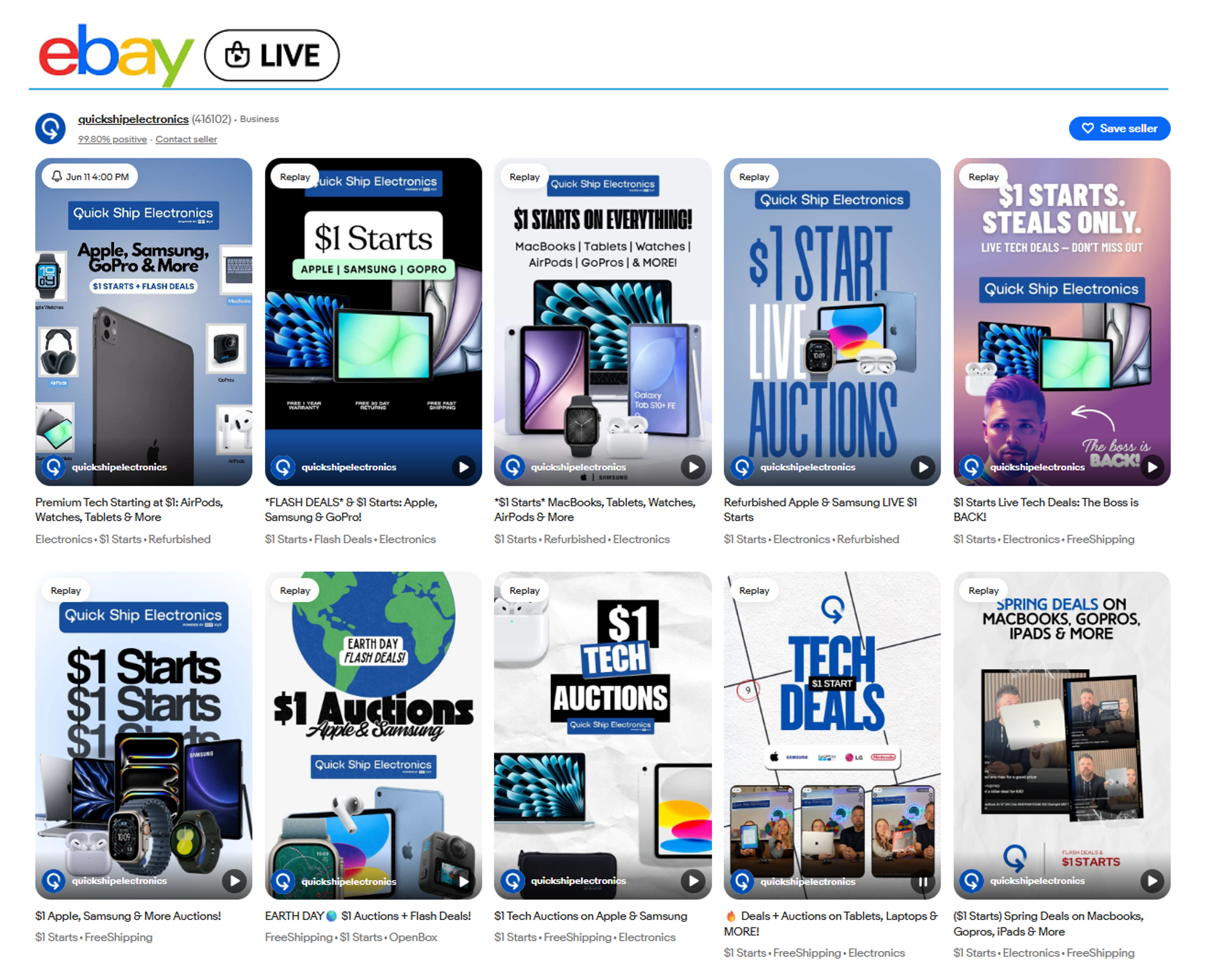
This shift matters because the market for used phones is already large, global, and growing fast. Recent estimates place the refurbished and used mobile phone market at around $73 billion in 2025, with forecasts climbing to over $130 billion by 2030.1 If live-selling platforms can capture even a modest share of that flow, they could establish a meaningful new commerce channel at the intersection of sustainability, mobile upgrades, and social shopping. Some resellers, such as Newegg and Quick Ship have started to leverage this channel.2
But the opportunity is harder than it looks. Platforms that treat used phones like any other live-selling category are likely to burn credibility rather than build it. The ones that win will do something different: they will build the specific trust infrastructure that used phones require.
Why Phones Are Attractive
Used phones have three traits that make them appealing to live-selling platforms: scale, repeatability, and velocity. Smartphones are one of the most in-demand categories in consumer electronics. When people upgrade their phones, it creates a constant flow of devices back into the secondary market, and buyers often respond quickly when they believe they are seeing a well-priced unit in scarce supply.
The category also benefits from meaningful macroeconomic tailwinds. As new flagship phones get more expensive, more consumers are turning to used and refurbished options.3 Concerns about sustainability and affordability have made second-hand devices appealing to more than just bargain hunters. Live selling is not trying to create a new market for used phones. It is trying to capture part of an already substantial and expanding resale flow.
For live-selling platforms thinking beyond phones, there is an additional layer of opportunity. Phones are not just consumer products; they are gateways into broader questions of recommerce, trust infrastructure, reverse logistics, and data-enabled verification. A live-selling platform that learns how to sell used phones well is simultaneously learning how to support other high-value, condition-sensitive categories over time. Getting phones right is a proof of concept with compounding value.
Who Is Competing?
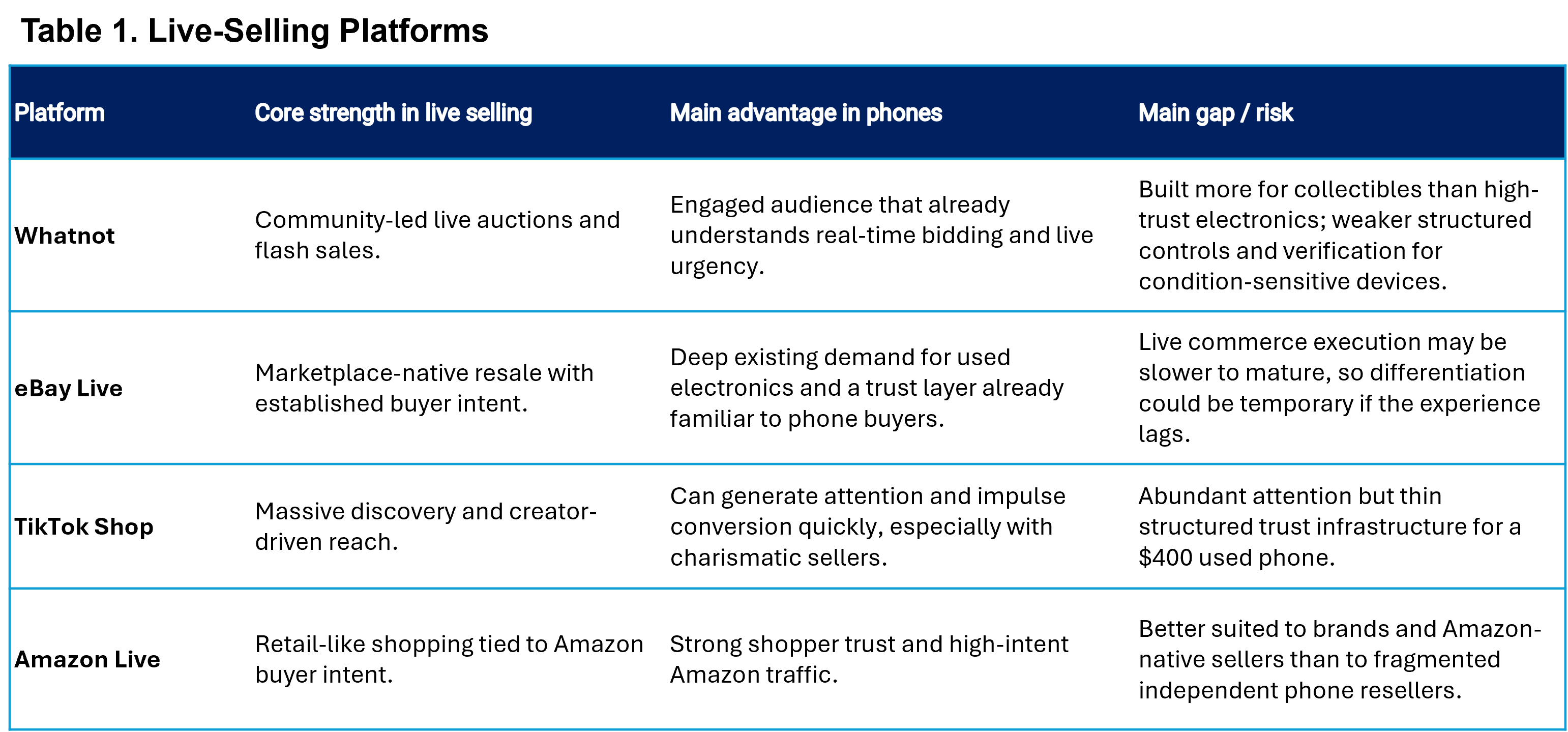
The competitive field is taking shape, but no platform has yet fully claimed used phones as its defining live-selling category. Each of the leading contenders brings meaningful strengths and meaningful gaps (see Table 1).
Whatnot has built a strong identity around community-led live auctions and flash sales. Its audience is engaged and accustomed to real-time bidding energy, and its electronics presence has grown. But Whatnot’s model was built for collectibles and categories where the excitement of the show often is the product experience. Used phones require a different kind of trust, and Whatnot has not yet demonstrated the structured seller controls or verification infrastructure that high-value electronics demand.
eBay Live may have the most natural structural advantage of any platform. eBay already has deep buyer intent for used electronics, an established trust layer, and direct experience with consumer smartphone resale. Its live format gives it a chance to combine its strategic focus on the circular economy with the engagement of livestream commerce.4 The risk is execution: eBay has historically been slow to develop live commerce, and the window for differentiation is not unlimited.
TikTok Shop brings a different strength — discovery at a massive scale. TikTok can generate attention faster than almost any commerce channel, and for sellers with a compelling on-camera presence, conversion can follow quickly. But TikTok’s challenge with high-value, condition-sensitive categories is the opposite of eBay’s: attention is abundant, but structured trust infrastructure is thin. A platform optimized for $30 impulse purchases faces real hurdles when the transaction is a $400 used iPhone.
Amazon Live is Amazon's live-streaming platform where brands and influencers show products in real time to shoppers who are ready to buy on Amazon. These streams appear on product detail pages and in the Amazon app, with clickable product carousels that link directly to checkout. This makes Amazon Live similar to digital QVC, rather than the auction-style live selling on Whatnot or eBay Live. The platform works best for brands and sellers who use Amazon's fulfillment services, have consistent inventory, and advertise on the site. It's not as suitable for independent resellers who sell one-off items. For high-value items like used iPhones, Amazon Live is set up for new or "like-new" products from established sellers, rather than items that need careful grading and individual sales, which is more common on secondary-market platforms.
This means that no single platform is guaranteed to win. Instead, the competition is open, and the key to success lies in differentiating oneself within the category.
Why Smartphones are Different
Unlike beauty products or streetwear, smartphones are a complex technology that requires precise technical verification before purchase. In addition, they don't work on their own. A phone needs to connect to a network and have a data plan to function. Since they are expensive items, often costing between $300 and $800 even for used devices, they are a prime target for fraud. Their high value, small size, and ease of transport make them easy for criminals to sell on the black market or ship to other countries for a quick profit.5
A buyer considering a used iPhone or Samsung device typically wants precise answers about model, storage, battery health, cosmetic condition, carrier lock status, activation lock status, repair history, included accessories, warranty terms, and return rights — before completing a purchase.
These factors create a very different operating challenge. In categories like beauty products or streetwear, the show itself often drives conversion: entertainment, rarity, social proof, and the fear of missing out do the work. With used phones, the show can help, but it cannot do all the work alone. The device must also be verifiable, service-eligible, and accurately described in ways that survive post-sale inspection.
Consider what can go wrong in a phone transaction that would never arise with items typically sold on live-selling platforms. The device could be carrier-locked to a network the buyer does not use. It could be blacklisted due to an unpaid carrier balance. It could have an undisclosed repair history that affects resale value or water resistance. It could still be logged into a previous owner’s Apple ID, rendering it a very expensive paperweight.
There is also the problem of network band compatibility.6 A phone manufactured for one regional market may lack the radio bands required by a buyer’s carrier — even if it is fully unlocked and passes every verification check. A consumer who buys an Asian-market variant of a flagship device may find it connects to LTE but drops to 2G in their city, or misses 5G bands entirely. This is not a defect; it is a hardware specification mismatch that no IMEI check will catch, and that most buyers have no way to identify without guidance.
None of these problems — carrier lock, blacklisting, undisclosed damage, or band incompatibility — are visible on camera. All of them destroy buyer trust when they emerge after the sale. And they do not all surface at the same moment. A blacklisted phone fails on activation. A carrier-locked phone fails on the first SIM swap. A band-incompatible phone may appear to work initially — calls connect, basic data loads — and only reveal its limitations later when the buyer notices poor indoor coverage, missing 5G, or dropped calls in areas their previous phone handled fine. That delayed failure pattern is harder to adjudicate in a dispute and easier for a bad-faith seller to deny.
This is the trust problem at the heart of live phone selling — and it is not solved by better video production or a more enthusiastic host.
What Live Selling Does Well
Despite those challenges, phones are not incompatible with live selling. In fact, live video can solve some problems that static listings handle poorly.
A seller can show the exact device, rotate it to show cosmetic condition, demonstrate the screen, camera, ports, and boot-up sequence, and answer questions in real time battery indicators and network compatibility. That matters because trust in used devices is often built through evidence, not description. A polished listing can claim a device is in excellent condition; a livestream can let buyers see the evidence and interrogate it on the spot.
For premium inventory, such as curated drops, flagship iPhones, thoroughly tested Androids, that combination of live demonstration and purchase urgency could lift conversion meaningfully above what static resale channels deliver. In this sense, live selling is most likely to succeed as a complementary channel rather than a replacement for existing resale infrastructure. Search-led marketplaces, trade-in programs, and traditional recommerce sites will continue to dominate standardized flows. These are well-established channels. But livestreams could create a viable venue for higher-margin moments, faster inventory turns on premium units, and audience-driven resale events that create genuine excitement around exceptional inventory.
The format has real potential. The question is whether platforms will build the infrastructure to support it properly.
What Platforms Must Do to Win
If live-selling platforms want used phones to become a real category rather than perpetual pilots, generic livestream tooling is not enough. Winning requires building category-specific trust infrastructure across five distinct areas.
1. Structured Data Requirements
Platforms must require sellers to disclose standardized fields for every listed device: model, storage capacity, battery health percentage, carrier lock status, supported frequency bands and regional market variant, cosmetic grade, repair history, included accessories, warranty terms, and return policy. Without that structure, live selling remains too dependent on improvisation and improvisation is a poor foundation for a high-value electronics category where disputes are common and returns are expensive.
The inclusion of frequency band and regional variant data is not a minor detail. It is the only way buyers can verify network compatibility before purchasing. A platform that mandates this disclosure closes a gap that no verification database currently covers.
This is a necessity, not an option. A platform that establishes clear, mandatory disclosure standards will be materially harder to defraud on and materially easier to trust than one that allows sellers to describe inventory however they choose.
2. Verification Infrastructure
The single most important step platforms can take is to connect their commerce systems to existing telecom-grade verification systems.
Every used phone has a unique IMEI number that can be checked against the GSMA Device Check database and carrier block lists to determine whether a device is clean, service-eligible, and not reported stolen or blacklisted.7 These verification systems already exist. They are used by carriers, insurers, and professional recommerce companies. Live-selling platforms need to integrate them into the transaction flow.
The design logic here matters. Rather than asking buyers to trust individual sellers, platforms should shift part of the trust burden to system-level validation. A buyer who sees that a device has passed an IMEI check against the GSMA block list has meaningful evidence — not a seller’s assurance — that the device is not stolen and can be activated on a carrier network.8 Layering in device-history services that flag repair records or prior damage reports adds another verification layer that static listings typically cannot provide.
It is equally important to be clear about what IMEI verification does not cover: network band compatibility. Whether a device supports the specific frequency bands used by a buyer’s carrier is a hardware question, not a registry question. It requires separate disclosure at the point of listing, which is why the structured data requirement above is not optional.
Platforms that treat verification as an afterthought will find that used phones generate an unsustainable volume of post-sale disputes. Platforms that build verification into the transaction moment will find that buyer confidence converts — and that the verified-device layer becomes a competitive differentiator, not just a cost.
3. Workflow Design for High-Value Transactions
High-value electronics require stronger controls than most live-selling categories. Platforms need seller verification processes that screen out bad actors before they can run live sessions, dispute-resolution rules designed specifically for condition-sensitive electronics, and clear buyer protections with visible return rights, payment escrow, and audit trails that document what was shown and claimed during the livestream.
Shipping standards matter too. Platforms need to specify packaging requirements, carrier requirements, and insurance thresholds that reflect the value of the goods and the realistic rate of transit damage. None of this is glamorous, but all of it determines whether the category builds durable repeat trust or generates a steady accumulation of avoidable disputes.
4. Seller Acquisition Strategy
The supply side of this market is as important as the viewer experience. Used phones will not become a real category unless platforms attract the resellers and refurbishers that control meaningful volumes of well-tested, properly graded inventory.
The most attractive supply-side partners are certified refurbishers, trade-in and buyback businesses, phone wholesalers with curated inventory, and specialty mobile resellers focused on premium devices. These operators already have the discipline that live phone selling requires: testing protocols, cosmetic grading systems, fulfillment infrastructure, and the ability to answer condition-specific questions in real time.
Not every reseller is a good fit. Pure commodity sellers that compete only on price, or operators with inconsistent grading and weak customer service, are less likely to benefit from a live format that exposes every weakness in process and presentation.
The strategic implication is clear: platforms need a deliberate reseller acquisition strategy, not just a viewer growth strategy. The platforms that best understand the structure of the resale supply chain — who has premium inventory, who has the operational discipline to perform on camera, who has the reputation to sustain buyer confidence —will have the strongest foundation for making used phones a real, live-selling category.
5. Education for Both Sides of the Transaction
The final requirement is education, and it runs in both directions.
Sellers need training on how to present phones properly on camera, specifically how to demonstrate boot-up, navigate to battery health screens, show port condition, test cameras, and display cosmetic flaws honestly. A seller who cannot confidently show a phone’s battery health percentage on camera is not ready to sell premium phones in a live environment.
Buyers need clear guidance on what terms like refurbished, used, tested, certified, and as-is actually mean in the context of a livestream purchase. These terms carry very different implications for device condition, warranty coverage, and return rights. Buyers also need to understand network compatibility — specifically, that an unlocked phone is not the same as a compatible phone, and that regional variants can affect band support in ways that are not obvious at the point of sale.9
Platforms that invest in seller preparation and buyer literacy will have fewer disputes, higher repeat purchase rates, and a category reputation that attracts better supply over time.
What Could Go Wrong
If the verification and disclosure infrastructure is not in place before the category scales, early buyers will encounter problems that static listings handle better: devices that turn out to be locked, batteries that are worse than claimed, phones that connect but perform poorly due to band incompatibility, and condition disputes that platforms cannot adjudicate fairly. Word travels fast in commerce communities. A category that develops a reputation for post-sale headaches will lose buyers faster than it can acquire new ones, regardless of how good the live experience feels in the moment.
There is also a seller-quality trap. If platforms move too quickly on onboarding sellers without screening for operational discipline, they risk populating the category with the wrong supply. This includes operators with inconsistent inventory and poor customer service who perform poorly on camera and generate disproportionate disputes. Live shopping platforms have navigated versions of this problem; phones will present a sharper version of it.
The cautionary lesson from other live-selling categories is that format novelty buys attention but not loyalty. Attention is the easy part. Building a sophisticated trust layer in a category where the purchase decision carries real financial risk is where the actual work is.
Category Growth Strategy
The most realistic path to making used phones a durable live-selling category is not onboarding as many sellers as possible at the outset. It is systematically testing the specific elements that determine whether live commerce actually works for this product class.
Before scaling aggressively, platforms should validate five things. First, they need to identify which trust signals actually reduce buyer hesitation. Second, they must determine which reseller types succeed in a live environment. Third, platforms should test whether live selling genuinely improves sell-through, average selling price, or margin relative to existing resale channels. Fourth, they need to figure out how to surface the verification layer to buyers at the point of transaction, including the limits of IMEI checks around band compatibility. Fifth, platforms must define what the full post-sale workflow needs to look like to avoid disputes.
Platforms that address those issues before scaling will build a better playbook for growth. Those that skip the strategy and move straight to seller onboarding will find that phones expose every weakness in their trust infrastructure faster than any other category they have tried.
Conclusion
Live commerce has worked well in categories that share a common profile: easy to show, easy to evaluate quickly, and easy to buy on impulse. Used phones are different in every one of those dimensions.
A buyer who pays $400 or more for a phone that turns out to be band-incompatible with their carrier has not just had a frustrating shopping experience — they have bought a device that looks fine on camera, passed every available check, and still fails to meet their basic needs. The platform that enabled that transaction bears real reputational responsibility for it.
That is not a reason to avoid the category. It is a reason to approach it seriously. Platforms that build real trust infrastructure for used phones, including structured disclosure, telecom grade verification, compatible band transparency, and educated sellers, will not just win a share of a market headed toward $130 billion. They will have demonstrated that live commerce can handle consequential transactions responsibly. That is a foundation worth building.
Exclusive masterclass at Mobile Disrupt 2026 in Miami. On July 6th, Rich Bulger and I will do dive deep into the live selling of smartphones. We will explore why this category is strategically unique, the trust infrastructure platforms must build, and what it takes to make used phones a real category rather than a perpetual pilot.
For more information see:
Mobile Disrupt Masterclass: https://mobiledisrupt.com/master-class-essentials-from-circular-logistics-to-business-innovation/
Footnotes
