
Five Software Companies Shaping the Circular Economy Tech Stack
Foxway | Gierd | Evercycle | LoopOS | Clarity Systems


Software has traditionally been designed to support the linear economy, focusing on managing and selling new products while overlooking the complexities of reverse logistics, returns, resale, repair, and recycling. However, this is changing. A new generation of circular economy software platforms is emerging to handle the multi-lifecycle value of products, providing infrastructure for businesses to extend asset life, recover value from returns, and operate truly regenerative commerce models.
This developing circular tech stack is being defined by companies that turn neglected burdens into efficient, data-driven capabilities for brands, retailers, and IT managers. These emerging software solutions enable brands to manage products across multiple lifecycles by automating reverse logistics, refurbishment, resale, and return processes. They also ensure compliance and trust through legitimate licensing, fraud detection, and traceability, while optimizing operations with data-driven dashboards, AI-powered pricing, and workflow orchestration.
In various ways, they provide infrastructure to unify fragmented data streams from marketplaces, streamline inventory and reverse logistics, automate condition-based valuation and relisting, and ensure ESG, financial, and regulatory reporting. By integrating buyback, repair, resale, recycling, and fraud prevention into cohesive, scalable digital systems, these platforms transform traditionally costly, manual processes into efficient, transparent, and circular operations that protect margins.
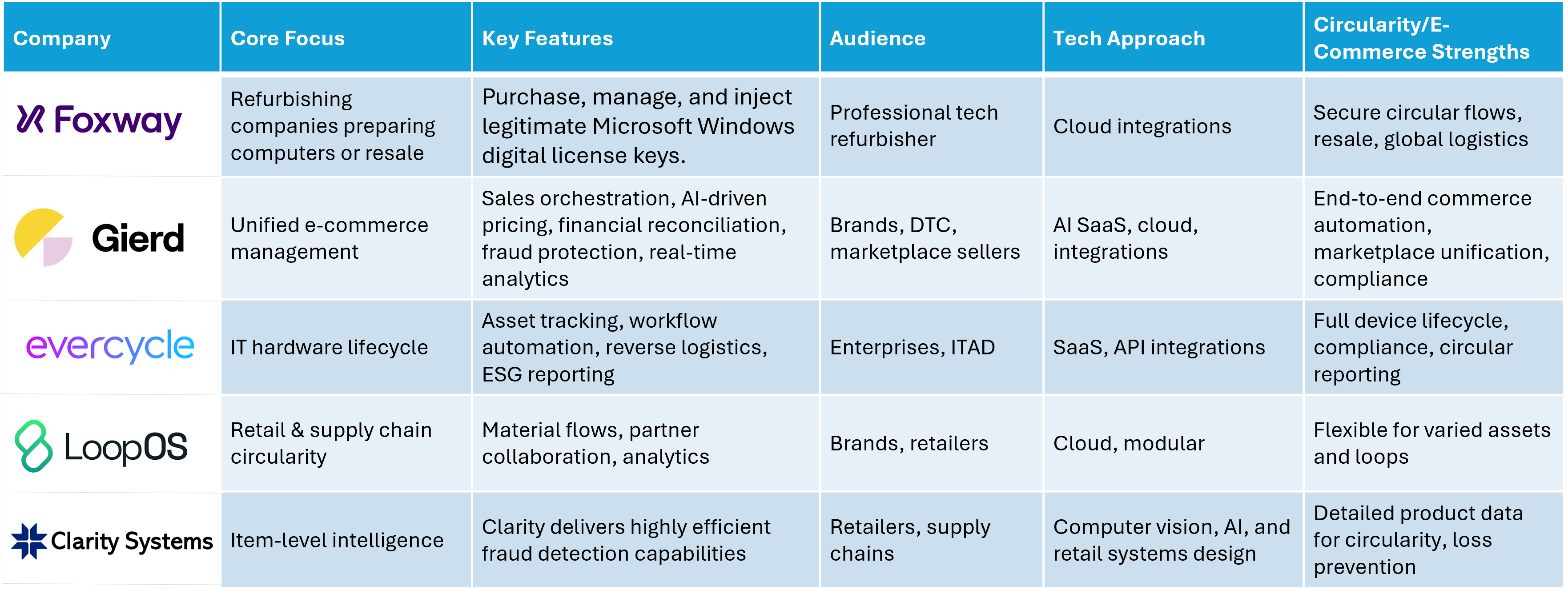
In the rest of this article, I review five companies focused on building circular software solutions for the circular economy. These companies include Foxway, Gierd, Evercycle, LoopOS, and Clarity Systems (see the summary Table below).
I’ve benefited from speaking with leaders and founders from each of these companies. Three of these conversations were captured through indepth conversations on the All Things Circular podcast.
Foxway
Foxway specializes in circular tech services that extend the life cycle of IT equipment, such as computers and mobile devices.1 Founded in Sweden and operating across multiple countries, Foxway supports businesses and organizations by providing sourcing, leasing, refurbishment, and resale of IT assets. Their comprehensive service model enables devices to be used multiple times, significantly reducing environmental impact and minimizing electronic waste. Foxway’s offerings include Device-as-a-Service solutions, trade-in and refurbishment programs, and a range of lifecycle management services designed to give customers full control and transparency over their IT equipment from purchase to end-of-life disposal.
The Foxway Smart Key, also known as SMART Digital Key Injection, is a cloud-based digital licensing solution designed to simplify and accelerate the process of injecting genuine Microsoft Windows licenses into refurbished computers.2 It automates the entire licensing workflow, enabling refurbishers to complete these steps with a single click and in under 30 seconds. Since it is cloud-based, no expensive or complex onsite hardware, servers, or VPNs are required; refurbishers can get started quickly with software accessed securely online.
SMART Digital Key Injection also features SMART Shield, which prevents duplicate license usage by detecting previously injected devices, saving refurbishers both time and licensing costs. The platform provides real-time analytics and reporting, allowing companies to monitor every license injection, track device statistics, and maintain visibility across multiple facilities and teams via a unified dashboard. Additional capabilities, such as automatic detection and installation of missing drivers, firmware updates, and removal of obsolete Autopilot profiles, help maintain device quality and compliance with refurbishing standards.
For companies engaged in computer refurbishment, the Foxway Smart Key offers significant benefits. It removes bureaucratic hurdles by giving immediate Third Party Refurbisher (TPR) status, eliminating the need for lengthy Microsoft certification processes. This speeds up turnaround times, reduces operational complexity, and ensures compliance with Microsoft’s Authorized Refurbisher program, so that every device refurbished carries a legitimate Windows license. The authentic licenses allow refurbishers to display the “Genuine Microsoft Refurbished” label, boosting consumer trust and confidence in the refurbished products. Furthermore, the solution’s cloud-based nature means refurbishers of any size, from small local shops to large multi-site operations, can scale efficiently without costly infrastructure investments.
Gierd
Gierd is an Idaho-based technology company offering an intelligent Unified Marketplace-Commerce Platform designed specifically for enterprise brands and retailers seeking to scale their direct-to-consumer (DTC) business across multiple online marketplaces.3 This platform replaces the fragmented approach many brands currently use, where they patch together internal tools and spreadsheets with disjointed data feeds, leading to inconsistent data and making it impossible to trust brand grading or pricing integrity across channels.
Gierd’s software system provides several key capabilities. It consolidates sales, pricing, inventory, and supply information, turning fragmented data from Amazon, Walmart, and other sites into structured, audit-ready financial records. Gierd’s AI-powered pricing and forecasting dynamically align inventory, anticipate market shifts, and automate corrective actions. The platform features advanced demand planning, profitability insights, reconciliation at SKU and transaction level, and proactive fraud and compliance controls—all aimed at delivering full visibility and operational mastery for brands scaling DTC and marketplace business lines.
Gierd supports circular “resale” transactions and complete commerce by providing brands and enterprises with technology that efficiently manages the resale of refurbished and second-life products across a wide range of online marketplaces. Through robust integrations with major channels like Amazon, Walmart, BackMarket, and others, Gierd unifies sales, pricing, inventory, refunds, and supply information into a single, structured dashboard—making it easy to list, track, and optimize the placement of both new and secondhand goods.
For resale inventory, Gierd enables automated, real-time pricing optimization, taking into account SKU condition, competitor benchmarks, and profitability thresholds. The platform’s dynamic pricing engine means sellers can maximize value recovery for returned or refurbished items by quickly adjusting prices to market demand and competitor movements. Gierd tracks every listing’s lifecycle across all connected marketplaces, monitors listing health and compliance, and provides detailed audit trails for every transaction or adjustment—ensuring full traceability for circular flows and simplifying compliance for resale programs.
In addition, Gierd’s command center approach streamlines catalog management, marketplace content optimization, and customer return data analytics. This helps brands quickly re-list returned or refurbished products, improve listing performance, and reduce friction in reverse logistics—from intake through resale. By connecting operational, financial, and compliance data, Gierd creates a transparent and efficient infrastructure for brands to execute end-to-end commerce—including buy new, resell used, and recycle returns—bringing true circularity to their digital sales ecosystem.
Evercycle
Evercycle’s SaaS platform is a comprehensive solution designed specifically for IT asset managers and managed service providers to automate and optimize the entire IT hardware lifecycle.4 It replaces labor-intensive manual processes with real-time tracking, automation, and seamless workflows that span every stage of the device lifecycle—from deployment and repair to replacement, retrieval, and recycling. This end-to-end control is enabled via an intuitive, customizable dashboard that unifies multi-vendor orchestration, cross-team collaboration, and reporting.
The platform integrates a broad ecosystem of service providers and tools, enabling organizations to automate device routing to the right partners globally, reducing the complexity of managing multiple vendors and locations. Evercycle’s workflow engine allows teams to configure automations tailored to their specific IT asset lifecycle needs, whether that’s refreshing hardware, extending device life, or securely decommissioning equipment with audit-ready compliance and data destruction certificates.
One of Evercycle’s key strengths lies in its robust data capture and reporting capabilities. The platform captures detailed, time-stamped information across every transaction and device movement, providing a complete chain of custody history. This comprehensive data supports regulatory compliance, security requirements, and ESG (environmental, social, and governance) reporting. Organizations gain actionable insights through prebuilt dashboards and analytics that highlight asset utilization, repair versus replacement decisions, and sustainability impact, helping maximize the ROI from IT assets while reducing environmental footprint.
Evercycle’s support for sustainable IT hardware management means organizations can implement hands-free circularity programs at scale, keeping teams productive while protecting data and minimizing waste. Its white-labeling and API integrations with existing enterprise systems ensure flexibility and rapid deployment, making it suitable for diverse industries including corporate, government, education, and managed services. Real-world use cases, such as recovering thousands of devices across distributed locations within tight timelines with minimal disruption, demonstrate Evercycle’s ability to drive operational efficiency and accountability throughout IT asset circularity.
LoopOS
LoopOS is a circular economy ERP platform that streamlines every stage of a product’s journey, from its creation to eventual reuse and recycling, all through a user-friendly drag-and-drop interface.5 This platform supports organizations in building practical, profitable circular business models while managing processes such as trade-in, repair, refurbishment, resale, and donation. LoopOS integrates seamlessly with logistics providers, workshops, online marketplaces, and internal company systems, allowing businesses to execute, monitor, and adjust circular initiatives at scale. Its modular and scalable architecture means each product can be routed through multiple reuse channels, which extends lifespans, maximizes value, and minimizes waste for businesses of all sizes.
LoopOS enables instant buyback and refurbishment programs that let customers estimate the value of their equipment, drop off items at post offices, and receive payment within 48 hours. This efficient process helps companies implement scalable takeback and resale strategies while improving the customer experience and tracking circularity KPIs throughout their operations. Several major companies—including Fnac, Auchan, Decathlon, MediaMarkt, Rowenta, Fidelidade, Sonae, and CTT—use LoopOS to power a variety of circular economy initiatives spanning retail, electronics, insurance, postal services, and consumer goods sectors. While businesses are eager to embrace these circular practices, they often encounter challenges with decision-making timelines; however, overall motivation to adapt and pursue circularity remains strong within the broader market ecosystem.
Clarity Systems
Clarity Systems has recently emerged from stealth mode.6 It is a retail focused technology company that addresses the growing problem of return fraud, which costs the industry over $150 billion annually with 15% of all returns being fraudulent. The company has developed “Item Intelligence,” a sophisticated system that combines radiography, computer vision, and artificial intelligence to analyze returned items in under three seconds and detect various types of fraud and product issues at the point of return.
The system’s fraud prevention capabilities are comprehensive, automatically detecting empty box returns, receipt scams, counterfeit products, item swaps, and tampered or resealed packaging. It can also flag repeat offenders without requiring retail associates to make difficult judgment calls. Beyond fraud detection, Clarity ensures product integrity by identifying missing accessories, such as chargers and cables, as well as missing internal components, incomplete bundles, and electronics. It also detects damaged enclosures, broken screens, software defects, activation locks, battery failures, and organic material issues relevant to apparel returns.
From an operational standpoint, Clarity stops fraudulent returns before refunds are issued, ensures only complete and undamaged items are restocked, and provides concrete evidence for disputes and chargebacks. The physical scanning part of the technology can be deployed in retail locations. This protects brand equity by keeping counterfeit goods out of inventory while eliminating the guesswork that retail associates typically face when processing returns. The system demonstrates impressive performance metrics with five-second item enrollment, three-second scan times, 99% verification accuracy, and a database containing over 95,000 items with more than 10,000 scans processed. The company was founded by retail product experts with decades of combined experience in returns, reverse logistics, retail operations, computer vision, AI, and large-scale product development.
Conclusion
The rise of circular economy software signals a significant change. Rather than viewing returns, resale, repair, and recycling as added extras or expenses, these platforms make them a core part of how brands create value. Companies such as Foxway, Gierd, Evercycle, LoopOS, and Clarity Systems show how digital tools can turn disjointed, manual tasks into efficient, clear, and profitable systems. These systems extend product lifecycles, build trust with customers, and ensure businesses comply with regulations.
Together, they suggest a future where items are bought and sold multiple times, and companies no longer see the initial sale as the end of a product’s value. This wave of software innovation will not only help the circular economy grow but will also redefine what makes a business competitive.
Footnotes
https://www.foxway.com/en/
https://smartdpk.com/
https://www.gierd.com/
https://www.evercycle.io/
https://www.getloopos.com/
https://claritysystems.ai/